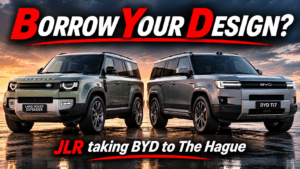
The JLR BYD legal dispute has intensified, with Jaguar Land Rover pursuing intellectual property allegations involving the BYD Ti7, a Defender-like SUV that has already received approval for sale in Australia.
Court-appointed bailiffs reportedly seized digital records from BYD’s offices in the Netherlands in August 2026, ahead of legal proceedings in The Hague.
The dispute centres on allegations that BYD’s Ti7 infringes intellectual property associated with the Land Rover Defender, including concerns about possible reverse engineering of technology.
The allegations remain unproven, and no court has determined that BYD infringed JLR’s intellectual property rights.
However, the case raises wider questions about automotive design, brand identity and the increasingly competitive market for premium SUVs.
JLR BYD Legal Dispute: What Has Happened?
According to reporting by The Times and The Guardian, bailiffs acting on behalf of Jaguar Land Rover searched BYD premises in Schiedam and Hoofddorp in the Netherlands.
The operation was reportedly authorised by a court and involved securing electronic records relevant to JLR’s intellectual property claims.
The British manufacturer is concerned that BYD may have copied protected technology or design elements associated with the Defender during development of the Ti7.
BYD’s legal representatives have reportedly challenged the scope of the document seizure, describing the action as excessive.
Proceedings in The Hague are examining preliminary legal and evidentiary issues.
Both manufacturers have declined to comment publicly on the substance of the ongoing litigation.
The distinction between an allegation and a legal finding is important. Visual similarities between vehicles do not, by themselves, establish intellectual property infringement.
BYD Ti7 Already Approved for Australia
The legal dispute has particular relevance to Australia because the BYD Ti7 has received Australian Design Rule certification, paving the way for a potential local launch.
The seven-seat plug-in hybrid SUV has a distinctly upright, boxy appearance that has attracted comparisons with the Land Rover Defender.
Australian approval documents identify two powertrain configurations:
- 200kW two-wheel-drive plug-in hybrid
- 300kW all-wheel-drive plug-in hybrid
The Australia-bound model measures 5,146mm long, 1,995mm wide and 1,865mm tall, with a 2,920mm wheelbase.
That makes it longer than the Toyota LandCruiser 300 Series.
The Ti7 is sold in China under BYD’s Fangchengbao brand, which produces several rugged-looking SUVs.
Unlike traditional body-on-frame off-road vehicles, the Ti7 uses a monocoque construction.
Although regulatory approval has been granted, BYD has not confirmed Australian pricing or an official launch date.
BYD Ti7 Could Undercut the Defender by More Than £20,000
The pricing difference between the two vehicles is another important part of the story.
The Ti7 is reportedly scheduled to enter the British market in January 2027 with a starting price of approximately £47,995.
By comparison, the seven-seat Land Rover Defender 110 has been reported with a starting price of approximately £68,465.
That represents a difference of more than £20,000.
The vehicles are not identical in their construction, capabilities, equipment or market positioning.
Nevertheless, buyers comparing large, distinctive SUVs may see two vehicles with similar visual characteristics at substantially different price points.
For JLR, the Defender’s value extends beyond its physical dimensions and equipment.
The brand has decades of history associated with off-road capability, distinctive styling and a recognisable identity.
Protecting that identity becomes increasingly important when competitors offer vehicles that attract comparisons at considerably lower prices.
Jaecoo 7 Becomes Britain’s Best-Selling Car
The JLR dispute is occurring alongside another significant development in the British automotive market.
The Jaecoo 7, a Chinese SUV whose styling has frequently been compared with Range Rover vehicles, was the UK’s best-selling new car in both September and October 2026.
According to the Society of Motor Manufacturers and Traders:
- September 2026: 10,813 Jaecoo 7 registrations
- October 2026: 3,412 registrations
- October ranking: First place, ahead of the Ford Puma
- 2026 performance: Three monthly first-place finishes through October
Jaecoo is part of Chery, one of China’s largest automotive manufacturers.
The brand’s rapid growth demonstrates that Chinese vehicles are no longer simply competing for customers seeking the cheapest available transport.
They are increasingly attracting buyers interested in styling, equipment, technology and the appearance traditionally associated with premium automotive brands.
The Jaecoo 7’s design has attracted informal comparisons with Range Rover vehicles, including the nickname “Temu Range Rover” in sections of the British motoring press.
That description is commentary, not a finding that Jaecoo has infringed anyone’s intellectual property.
However, its sales success highlights the commercial challenge facing established brands.
Manufacturers can spend decades building distinctive design identities, only to find newer competitors offering customers a familiar visual proposition at a much lower price.
JLR and Chery Already Have an Automotive Partnership
The relationship between British and Chinese automotive manufacturers is more complicated than simple competition.
Jaguar Land Rover has maintained a joint venture with Chery since 2012.
The companies have also been collaborating on the revival of the Freelander name as a separate electrified vehicle brand.
That relationship is distinct from Chery’s independently marketed Jaecoo vehicles.
It nevertheless illustrates how established manufacturers and Chinese automotive groups can simultaneously be commercial partners and competitors.
Chinese manufacturers are increasingly developing their own brands while also collaborating with international automotive businesses on technology, engineering and product development.
For established brands, those relationships can create valuable opportunities while introducing additional competitive pressures.
Inspiration, Imitation and Automotive Brand Identity
Automotive design has always involved shared trends and influences.
Manufacturers have borrowed styling themes from one another for decades, particularly in popular segments such as SUVs and four-wheel drives.
An upright windscreen, squared-off bodywork or distinctive wheel arches do not automatically establish unlawful copying.
However, the growing number of similarly styled vehicles raises a broader commercial question.
How much of a premium automotive brand’s value comes from its engineering and capability, and how much comes from its distinctive design and reputation?
If customers can purchase a vehicle with a familiar appearance at a substantially lower price, established manufacturers may face increasing pressure to justify their pricing.
That does not mean the cheaper vehicle necessarily offers equivalent quality, performance, safety or long-term ownership support.
But it does mean brand heritage alone may not be sufficient to retain every customer.
What Does This Mean for Australia’s Automotive Industry?
Australia is already experiencing substantial growth in Chinese automotive brands, with additional manufacturers preparing to enter the market.
The BYD Ti7’s approval adds another potential competitor to the large SUV segment.
For dealerships, expanding choice can create opportunities to represent new manufacturers and offer customers alternatives to established brands.
For premium manufacturers, it can increase pressure on pricing, product differentiation and customer loyalty.
For consumers, the benefits of competition include access to more vehicles, greater choice and potentially lower purchase prices.
The JLR dispute adds another dimension: the importance of protecting legitimate intellectual property rights while allowing manufacturers to compete through innovation and product development.
The outcome of the proceedings remains uncertain.
The bigger issue for Australia’s automotive market is that newer manufacturers are increasingly challenging not just the prices of established vehicles, but the design identities and reputations those brands have spent decades building.
The BYD Ti7 may be another example of how that competition develops.
Sources: The Times and The Guardian, 7–8 November 2026; CarExpert, 9 November 2026; UK Society of Motor Manufacturers and Traders, September–October 2026 vehicle registration results.