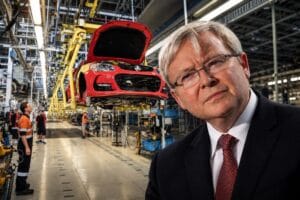
Australian car manufacturing could make a comeback if former prime minister Kevin Rudd’s vision becomes reality. But rebuilding Australia’s automotive industry raises an uncomfortable question: what has changed economically since Holden, Ford and Toyota closed their local factories?
During a September 2026 National Press Club address, Rudd argued that Australia should rebuild its automotive manufacturing capability, describing the loss of domestic car production as a weakness in national security and industrial self-sufficiency.
He suggested advances in electric vehicles and 3D printing could make a revival possible.
There are legitimate arguments for maintaining sovereign manufacturing capabilities, particularly in strategically important industries.
However, a return to mass-market passenger vehicle production would require Australia to confront many of the same economic problems that ultimately forced its major car manufacturers to close.
And this time, the competition is considerably stronger.
Why Did Australian Car Manufacturing End?
Australia once maintained a substantial automotive manufacturing industry supported by Ford, Holden, Toyota and an extensive network of component suppliers.
That industry created thousands of skilled jobs in engineering, manufacturing, maintenance, logistics and technical trades.
However, Australian production became increasingly difficult to sustain.
By 2013, Holden had identified a substantial difference between the cost of building vehicles locally and manufacturing comparable models overseas.
The company told the Productivity Commission that producing a vehicle in Australia cost approximately $3,750 more than at comparable General Motors plants in Asia.
Toyota was also seeking production-cost reductions of approximately $3,800 per vehicle.
Several structural factors contributed to the industry’s declining competitiveness, including relatively high production costs, limited economies of scale, international competition, exchange rates and the difficulty of maintaining a competitive domestic supplier network.
Ford ceased Australian vehicle manufacturing in October 2016. Toyota and Holden followed in October 2017.
The closures marked the end of Australian mass-market passenger car manufacturing.
Australian Car Manufacturing Received $30 Billion in Assistance
Government support was already a significant part of the industry’s business model.
In its 2014 automotive manufacturing inquiry, the Productivity Commission estimated that approximately $30 billion in combined government assistance had been provided to the Australian automotive industry between 1997 and 2012, expressed in 2011–12 dollars.
That figure included different forms of assistance and should not be interpreted entirely as direct taxpayer payments to vehicle manufacturers.
Nevertheless, the Commission concluded that decades of assistance had delayed, rather than prevented, the industry’s structural adjustment.
It also found that the broader economic costs of industry-specific assistance outweighed the benefits.
The problem was not that Australia lacked capable engineers, technicians or production workers.
Australia had developed considerable automotive manufacturing expertise.
The central problem was whether vehicles could be manufactured locally at costs that allowed the industry to compete sustainably.
That question remains relevant to any proposal to rebuild the sector.
China Has Transformed the Global Automotive Industry
Since Australia’s last major passenger vehicle factories closed in 2017, the global automotive industry has changed dramatically.
China has become a dominant force in vehicle manufacturing, particularly in electric vehicles, batteries and associated supply chains.
Its competitive position is supported by enormous production volumes, extensive component manufacturing networks, battery technology, automation and closely integrated supply chains.
The scale is difficult to comprehend.
According to figures from the China Association of Automobile Manufacturers, China exported approximately 6.25 million passenger vehicles in the first eight months of 2026 alone.
That exceeded China’s passenger vehicle exports for the entire previous year.
By comparison, Australia’s total annual new-vehicle market is approximately 1.2 million vehicles.
The figures are not directly comparable measures of production capacity: China’s number represents exports, while Australia’s represents domestic sales.
However, they demonstrate the enormous difference in the scale of the two automotive markets.
Chinese manufacturers are also competing aggressively on price, introducing new models rapidly and investing heavily in advanced automotive technology.
Any Australian manufacturer entering the mass-market passenger vehicle industry would need a business model capable of operating in that environment.
Could Electric Vehicles and Automation Change the Economics?
Rudd has suggested that electric vehicles and modern manufacturing technologies could create opportunities to rebuild Australia’s automotive industry.
There is a reasonable argument that manufacturing methods have changed since the closure of Holden, Ford and Toyota.
Electric vehicles have different powertrain requirements, while automation, advanced materials and additive manufacturing can create efficiencies in certain production processes.
However, those developments do not automatically eliminate the disadvantages associated with smaller production volumes.
Establishing a competitive vehicle manufacturing operation still requires substantial capital investment, equipment, specialist labour, supplier relationships, engineering capability and access to components.
Battery manufacturing and supply-chain integration are also major considerations.
Australia would need to determine whether to develop substantial local component production or rely heavily on imported parts.
The latter could make vehicle assembly more achievable, but it would also limit the extent to which domestic production reduced Australia’s dependence on overseas automotive supply chains.
A vehicle assembled in Australia using imported batteries, electronics and major components is not necessarily evidence of a self-sufficient automotive manufacturing industry.
The economic case would depend on what was manufactured locally, the volume produced and the value created.
Sovereign Capability Is Different From Commercial Viability
Rudd’s argument places considerable emphasis on national security and reducing Australia’s reliance on imported vehicles.
That is a different proposition from arguing that domestic passenger vehicle manufacturing would be commercially competitive without ongoing government support.
Countries sometimes maintain strategic manufacturing capabilities because of their importance to national security, supply resilience or critical infrastructure.
Such decisions can be justified on grounds other than short-term profitability.
However, the costs and benefits should be transparent.
If government support were required to rebuild Australian car manufacturing, policymakers would need to explain what capability was being purchased and why domestic vehicle production was the most effective way to achieve it.
The distinction matters because supporting a strategic manufacturing capability and establishing a profitable mass-market automotive business are not necessarily the same objective.
Where Could Australia Have a Manufacturing Advantage?
Australia continues to have strengths in specialised automotive engineering and vehicle modification.
Potential opportunities include specialist commercial vehicles, defence mobility, mining and agricultural equipment, heavy-vehicle systems, advanced components and conversion of imported vehicles for Australian conditions.
These markets can have different economics from high-volume passenger car production.
They may support smaller production runs, higher-value engineering work and specialised technical capabilities.
Australia also has resources and technical expertise relevant to battery materials, advanced manufacturing and certain elements of the electric vehicle supply chain.
These opportunities deserve consideration on their own merits.
A competitive Australian automotive manufacturing sector does not necessarily require the return of a high-volume Holden or Ford passenger car factory.
It may instead involve developing products and technologies where local expertise delivers a genuine commercial advantage.
What Would an Australian Car Manufacturing Revival Mean for Jobs?
From an automotive recruitment perspective, the potential return of manufacturing employment would be significant.
A successful automotive manufacturing sector could create opportunities for mechanical and electrical engineers, production technicians, maintenance specialists, apprentices, supply-chain professionals and experienced manufacturing managers.
The industry would also require investment in training, equipment and technical capability.
But the long-term value of those jobs depends on the sustainability of the businesses employing those workers.
Australia’s previous manufacturing closures demonstrated the personal and regional consequences of losing major industrial employers.
Rebuilding employment around a business model that requires continuing support without a clear long-term strategy could expose workers and communities to similar risks.
The employment benefits therefore need to be considered alongside production costs, competitiveness and the expected return on public investment.
Can Australian Car Manufacturing Compete Again?
Kevin Rudd’s call to rebuild Australian car manufacturing raises an important question about the country’s industrial future.
There is a strong case for examining Australia’s dependence on imported technologies, components and strategically important products.
There are also opportunities to develop advanced manufacturing capability and create highly skilled employment.
However, the economic evidence behind the closure of Australia’s original passenger vehicle industry cannot simply be overlooked.
In 2013, Holden identified a $3,750-per-vehicle production disadvantage. The industry had received substantial government assistance, and international competition was already intense.
Today, China operates an automotive industry with extraordinary manufacturing scale, integrated supply chains and rapidly advancing technology.
The question is not whether Australians are capable of building competitive vehicles.
It is whether a new Australian passenger vehicle manufacturing operation could produce them at a sustainable cost, attract sufficient investment and achieve the volumes needed to survive.
Until those questions are answered with a credible business case, the revival of mass-market Australian car manufacturing remains an ambition rather than a demonstrated commercial opportunity.
The more useful debate may be where Australian automotive manufacturing can deliver lasting economic value — and where our investment would be better directed elsewhere.