
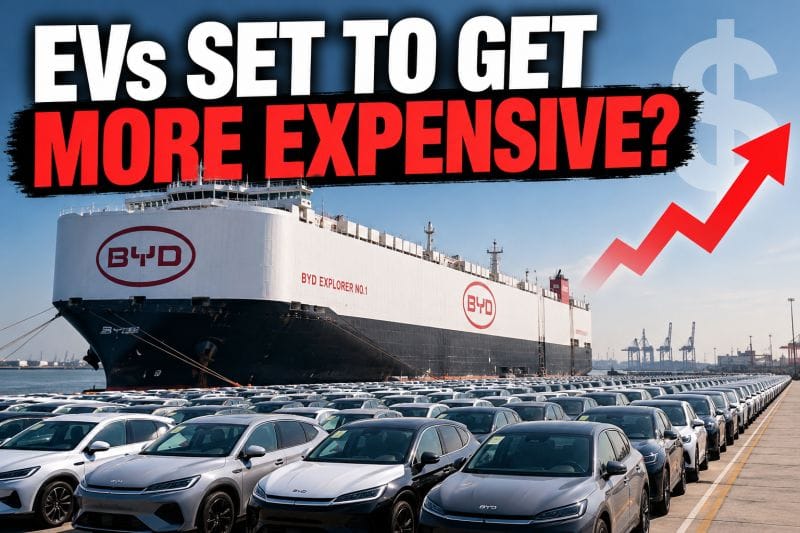
China has announced a reduction in export tax rebates for electric and plug-in hybrid vehicles, introducing a change that could increase costs for manufacturers supplying the Australian market.
From 1 April 2027, the Chinese government will reduce the value-added tax (VAT) export rebate for specified new-energy vehicles from 13% to 9%.
The change was announced on 12 October 2026 by China’s Ministry of Finance and State Taxation Administration.
It applies to battery-electric vehicles, plug-in hybrid vehicles and certain electric commercial vehicles exported from China.
Conventional petrol and diesel vehicles outside the affected categories will retain the existing 13% rebate.
The decision comes during a period of rapid growth in Chinese vehicle exports, including to Australia, where manufacturers such as BYD, MG, Geely, Chery and GWM have established significant market positions.
How the export rebate works
China’s VAT export rebate system allows manufacturers to recover eligible value-added tax associated with goods produced for export.
Under the current arrangements, qualifying new-energy vehicles receive a rebate at a rate of 13%.
From April 2027, that rate will fall to 9% for the vehicle categories covered by the new announcement.
The reduction means exporters will receive a smaller tax refund, potentially increasing the net cost of supplying vehicles to overseas markets.
The applicable rate will be determined by the export date recorded on the vehicle’s customs declaration.
This means vehicles exported before 1 April 2027 will remain subject to the existing arrangements, while qualifying vehicles exported from that date will fall under the reduced rate.
The change does not directly impose a new Australian import tariff or tax on consumers.
Instead, it changes the financial arrangements applying to vehicles exported from China.
Petrol and diesel vehicles retain the existing rebate
One notable feature of the announcement is the distinction between new-energy vehicles and conventional combustion-engine vehicles.
While the rebate for specified electric and plug-in hybrid vehicles will fall to 9%, the existing 13% rate will continue for conventional petrol and diesel vehicles outside the affected categories.
This creates different export rebate arrangements for vehicles manufactured in China according to their powertrain type.
The policy applies to eligible exports from China rather than exclusively to Chinese-owned automotive brands.
Consequently, Chinese-built vehicles produced by international manufacturers may also be affected where they fall within the relevant vehicle classifications.
What could it mean for BYD and other manufacturers?
The reduction has prompted analysis of the potential financial impact on Chinese automotive exporters.
According to industry reporting, Deutsche Bank estimates the change could reduce BYD’s net profit by approximately 5,000 yuan per exported vehicle, equivalent to roughly A$1,000 at the exchange rates used in contemporary reporting.
That estimate represents an anticipated financial impact on the manufacturer, not a confirmed increase in vehicle retail prices.
Other companies exporting qualifying vehicles from China may also face reduced rebates.
These include manufacturers associated with brands sold in Australia, such as Geely, MG, Chery and GWM, as well as Tesla’s Chinese-built electric vehicles.
The actual impact will depend on the vehicles involved, export values, manufacturer cost structures and the arrangements through which vehicles are supplied to overseas markets.
China’s growing electric-vehicle exports
The announcement follows substantial growth in China’s exports of new-energy vehicles.
According to the China Association of Automobile Manufacturers, China exported approximately 4.006 million new-energy vehicles during the first nine months of 2026.
That represented an increase of approximately 130% compared with the corresponding period in 2025.
September exports alone reached approximately 571,000 new-energy vehicles, an increase of around 160% year on year.
The figures include eligible passenger and commercial vehicles and cover exports to markets around the world, not just Australia.
They demonstrate the scale of the export industry affected by the policy change.
Australia is one of the overseas markets receiving Chinese-built electric and plug-in hybrid vehicles, alongside markets in Europe, Asia and other regions.
Will electric cars become more expensive in Australia?
The reduction in China’s export VAT rebate does not automatically mean Australian retail prices will increase by an equivalent amount.
Manufacturers and distributors have several possible responses to changes in their export costs.
They may absorb some or all of the additional cost, accept lower margins, adjust wholesale pricing or change the level of discounts and promotional support offered in individual markets.
The outcome will also depend on competition between brands, currency movements, shipping costs and vehicle supply.
Australian consumers have seen significant competition between electric-vehicle manufacturers, including price reductions and promotional campaigns across several brands.
Whether the reduced rebate changes that competitive environment will only become clear as manufacturers respond to the new arrangements.
No general increase in Australian electric-vehicle retail prices has been confirmed as a direct consequence of the October announcement.
What happens before April 2027?
The new rebate rate will not take effect until 1 April 2027, giving manufacturers and exporters several months to prepare.
Because the applicable rate depends on the customs export date, the timing of vehicle shipments will be relevant to the rebate received.
However, the announcement does not establish that manufacturers will accelerate exports, increase Australian vehicle stock or introduce further discounting before the deadline.
Those outcomes would depend on individual commercial decisions.
For Australian dealers and distributors, the key development is that the tax treatment of qualifying Chinese-built electric and plug-in hybrid vehicles will change from April 2027.
The extent to which that change affects wholesale costs, dealer pricing or consumer demand remains uncertain.
A confirmed policy change, but an uncertain price outcome
China’s decision reduces an existing export tax benefit for specified new-energy vehicles while leaving the rebate for conventional petrol and diesel vehicles unchanged.
The measure will affect the economics of qualifying vehicles exported from China, including models supplied to overseas markets such as Australia.
Deutsche Bank’s estimate of the potential impact on BYD provides an indication of the financial scale involved, but it should not be interpreted as a forecast of Australian showroom prices.
The confirmed facts are the reduction from 13% to 9%, the 1 April 2027 commencement date and the vehicle categories covered.
Whether Australian buyers ultimately pay more for Chinese-built electric and plug-in hybrid vehicles will depend on how manufacturers and distributors respond.
Sources: China’s Ministry of Finance and State Taxation Administration, 12 October 2026; China’s State Taxation Administration / Xinhua, 13 October 2026; China Association of Automobile Manufacturers; CnEVPost reporting on Deutsche Bank analysis, 12 October 2026.