
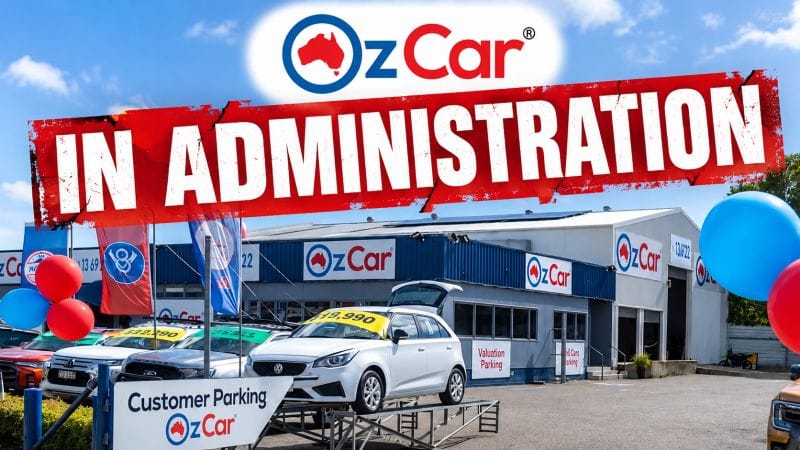
Australian used-car retailer OzCar entered voluntary administration on 8 October 2026, resulting in the immediate closure of four company-owned dealerships in New South Wales and the loss of 90 jobs.
Glen Kanevsky and Jason Tracy of restructuring advisory firm Alvarez & Marsal were appointed as voluntary administrators following action by the company’s secured creditor.
The affected locations were Lansvale, Penrith, Cardiff and Gosford.
The announcement marked a significant development for a used-car business that had operated in Australia for more than two decades and expanded through a combination of company-owned dealerships and independently operated franchises.
Importantly, the administrators confirmed that OzCar’s 12 independently owned franchise dealerships were continuing to trade at the time of the announcement.
From Australian Fleet Sales to OzCar
OzCar’s origins date to 1998, when the business began operating as Australian Fleet Sales.
The company was established by Brett Dale, Ian Dale and James Keepkie and developed its presence in the Australian used-vehicle retail market.
Its original operations focused on the sale of used vehicles before the business expanded its dealership network and associated automotive services.
The company adopted the OzCar name in 2016, having previously operated under the Australian Fleet Sales identity.
The rebranding established a more recognisable national retail identity as the company continued developing its dealership operations.
In 2021, OzCar outlined ambitions to expand to 50 dealerships, reflecting the scale of its growth plans at the time.
The business operated through a mixture of directly owned dealerships and independent franchise operators, a structure that became particularly important following the administration announcement.
Four company-owned dealerships close
The administrators confirmed that four OzCar-owned dealerships ceased trading immediately following their appointment.
The closures affected Lansvale and Penrith in Sydney, along with Cardiff and Gosford in regional New South Wales.
Lansvale also served as the company’s head office.
A total of 90 employees were made redundant as a result of the closures.
The administrators said their immediate priority was to assess the company’s financial position, review its operations and engage with affected stakeholders.
Those stakeholders included employees, customers, creditors, suppliers and franchise partners.
The initial announcement did not establish whether any of the closed locations would subsequently reopen or whether parts of the business might be sold.
What happened to OzCar’s franchise dealerships?
Although the four company-owned locations closed, the administrators made an important distinction regarding OzCar’s independently operated dealerships.
The company’s 12 independently owned franchise locations continued trading at the time of the administration announcement.
These businesses operated under the OzCar brand but were separate from the company-owned dealerships directly affected by the closures.
Alvarez & Marsal indicated that the administrators would continue supporting the franchise network while assessing the company’s position.
This distinction is important because the appointment of administrators to OzCar Pty Ltd did not automatically mean that every dealership using the OzCar name had ceased operating.
Customers and suppliers dealing with franchise locations were therefore in a different position from those connected with the closed company-owned sites.
Japanese investment in OzCar
OzCar’s ownership history also included investment from Japanese automotive group Optimus Group.
Optimus first acquired a 10% interest in the business in November 2019.
The Japanese company subsequently increased its holding to 20% in May 2021 and then to 30% in November 2021.
Through that investment, OzCar became an equity-method affiliate of Optimus Group.
Optimus operates across several areas of the automotive industry, including vehicle trading, logistics and related services.
Following OzCar’s administration, Optimus disclosed that it indirectly held a 30% interest in the Australian business.
The Japanese group referred to OzCar’s poor financial performance and governance concerns, including matters identified through an external review.
Optimus stated that voluntary administration had been considered appropriate in light of the company’s financial and business circumstances.
The administrators’ investigations were still at an early stage when the initial announcement was made.
NSW Fair Trading disciplinary action
The administration followed separate regulatory action announced by NSW Fair Trading on 24 September 2026.
The regulator reported that its investigation had identified unlawful sales practices across multiple OzCar dealerships in New South Wales between 2023 and 2025.
The matters included concerns about sales processes, explanations provided to customers and vehicles that did not meet acceptable quality standards.
NSW Fair Trading imposed disciplinary penalties and conditions on the company’s motor dealer licence.
The regulatory action was a separate development from the subsequent administration.
While both events formed part of OzCar’s recent history, the public information available at the time did not establish that the disciplinary action caused the company to enter voluntary administration.
The administrators were responsible for investigating the company’s financial position and determining the available options.
What voluntary administration means
Voluntary administration is a formal process under Australian corporate insolvency law.
Administrators take control of a company’s affairs and investigate its financial circumstances.
Their role includes assessing whether the business can continue operating, whether a restructuring arrangement may be possible, or whether liquidation is the appropriate outcome.
Creditors are provided with information about the company’s position and may be asked to consider proposals relating to its future.
The appointment of administrators does not automatically mean that a company will be liquidated.
In OzCar’s case, Alvarez & Marsal said it would undertake an urgent review of the business and its financial position.
No final outcome had been confirmed in the initial announcement.
What about existing OzCar customers?
The administration also created uncertainty for customers with outstanding vehicle purchases, servicing arrangements, warranty enquiries or other dealings with the affected company-owned dealerships.
The administrators established a dedicated contact address for enquiries:
Customers were encouraged to contact the administrators regarding matters connected with the business under administration.
The position of customers dealing with independently owned franchise dealerships could differ, as those locations continued operating at the time of the announcement.
A significant development in Australian used-car retailing
OzCar’s administration affected a business with a long history in Australia’s used-vehicle market, an established dealership network and international investment.
The immediate confirmed consequences were the closure of four company-owned locations and the loss of 90 jobs.
At the same time, 12 independently owned franchise dealerships remained operational, highlighting the distinction between the company’s different dealership structures.
The administrators’ investigations, the company’s financial position and any potential restructuring or sale process would determine what happened next.
Sources: Alvarez & Marsal, 8 October 2026; Optimus Group corporate disclosures; NSW Fair Trading, 24 September 2026; Australian Business Register.