Volkswagen Group has reported a €5.86 billion operating loss for the third quarter of 2026, equivalent to approximately A$9.2 billion, as falling Chinese vehicle sales, restructuring costs and major asset writedowns place increasing pressure on the global automotive manufacturer.
The Volkswagen Group financial results, released on 29 October 2026, reveal the extent of the challenges confronting one of the world’s largest automotive groups.
The German manufacturer, whose brands include Volkswagen, Audi, Porsche, Škoda, Bentley and Lamborghini, recorded a 38.5% decline in vehicle deliveries in China during the third quarter.
However, its financial difficulties extend well beyond the Chinese market.
Volkswagen Group Financial Results: The Key Figures
Volkswagen’s third-quarter results show a substantial deterioration in operating performance compared with the corresponding period in 2025.
| Financial measure | Q3 2026 |
|---|---|
| Operating result | €5.86 billion loss |
| Revenue | €75.3 billion |
| Global vehicle deliveries | 1.89 million |
| Global delivery change | Down 14.3% |
| China delivery change | Down 38.5% |
| Operating margin | -7.8% |
The operating loss compares with a €1.30 billion loss during the third quarter of 2025.
Across the first nine months of 2026, Volkswagen Group generated €233.4 billion in revenue, down 2.2% from the corresponding period in 2025.
Its operating profit for the nine-month period fell to just €71 million, compared with €5.41 billion a year earlier.
Porsche Writedowns and Restructuring Costs Weigh on Profits
A significant portion of the Volkswagen Group’s financial difficulties came from exceptional accounting charges and restructuring expenses.
The company recorded €8.7 billion in special items during the first nine months of 2026, including €7.8 billion in the third quarter alone.
These included:
- €6.4 billion in non-cash impairment charges relating to Porsche goodwill.
- Approximately €1 billion in impairment adjustments involving fully consolidated Chinese operations.
- Costs associated with restructuring and the planned sale of Volkswagen’s Osnabrück operation.
The distinction between ordinary trading performance and exceptional charges is important.
Excluding special items, Volkswagen recorded an operating profit of approximately €8.8 billion for the first nine months, representing an adjusted operating margin of 3.8%.
While the group remained profitable on that adjusted basis, its underlying performance was still below management’s expectations.
Volkswagen Sales in China Fall 38.5%
China remains one of Volkswagen Group’s most important international markets, but competition from domestic manufacturers continues to intensify.
The group delivered approximately 405,800 vehicles in China during the third quarter of 2026, compared with 660,300 in the corresponding period a year earlier.
That represents a decline of 38.5%.
For the first nine months, Chinese deliveries fell 30.2% to approximately 1.38 million vehicles.
Manufacturers including BYD and Geely have been expanding their domestic market presence, particularly across electric and plug-in hybrid vehicle segments.
Volkswagen’s established brands are competing against manufacturers offering increasingly broad model ranges, competitive pricing and rapidly developing electric vehicle technology.
The decline in Chinese deliveries has become a substantial challenge for a group that has historically relied heavily on the market.
Electric Vehicles Create Additional Profitability Pressure
Volkswagen’s financial results also highlight the challenges associated with transitioning towards electric vehicles.
The company reported that electric vehicles currently generate lower margins than its equivalent combustion-engine models.
A growing proportion of lower-margin electric vehicle sales, alongside reduced volumes of more profitable combustion-engine vehicles, is placing pressure on earnings.
However, demand is not falling everywhere.
Volkswagen reported 39% growth in European battery-electric vehicle orders during the first nine months of 2026.
Electric vehicles accounted for approximately 40% of the group’s European order bank at the end of September.
This demonstrates the complexity of the transition: stronger electric vehicle demand does not automatically translate into improved profitability.
Volkswagen Group Targets Major Cost Reductions
In response to its financial performance, Volkswagen is pursuing a comprehensive cost-reduction program valued at approximately €31 billion.
The strategy includes simplifying model ranges, reducing development costs, improving factory efficiency and lowering overheads.
Volkswagen has also identified trade restrictions, US tariffs and global pricing competition as significant challenges.
For the full 2026 financial year, the group expects revenue of approximately €315 billion, with an operating return on sales of up to 1%.
The forecast reflects the considerable pressure on profitability despite the company’s substantial global revenue.
What Do Volkswagen’s Results Mean for Australia?
The Volkswagen Group financial results highlight the increasing competitive pressure facing established automotive manufacturers.
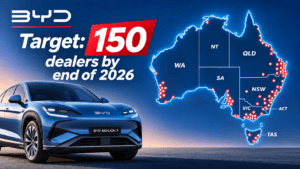
In Australia, Chinese manufacturers are expanding their dealership networks, introducing additional models and competing across a growing range of passenger vehicles, SUVs, electric vehicles and plug-in hybrids.
Meanwhile, established manufacturers must balance investment in electrification with the need to maintain profitability across their existing operations.
For Australian dealerships, these developments have implications for product availability, pricing strategies, manufacturer support and competition for market share.
Volkswagen remains one of the world’s largest automotive groups, supported by extensive engineering resources, established brands and international distribution networks.
However, the financial results demonstrate that scale and brand recognition do not provide immunity from changing market conditions.
The group’s challenge is to restore sustainable profitability while managing restructuring costs, expanding its electric vehicle portfolio and defending its position in increasingly competitive markets.
Volkswagen’s €5.86 billion quarterly operating loss illustrates the financial pressure facing established automotive manufacturers as the global industry undergoes significant change.
Source: Volkswagen Group, Third Quarter and Nine-Month Financial Results, 29 October 2026.